The 2026 World Cup is structurally different from every tournament before it. Forty-eight teams instead of thirty-two. Twelve groups instead of eight. A Round of 32 that didn't exist before. A third-place safety net that changes how half the field plans their group stage.
We ran the format through our model. The numbers tell a clear story: more football, more representation, and a sharper divide between the teams competing for the title and the teams competing to survive the group.
If you're just tuning in
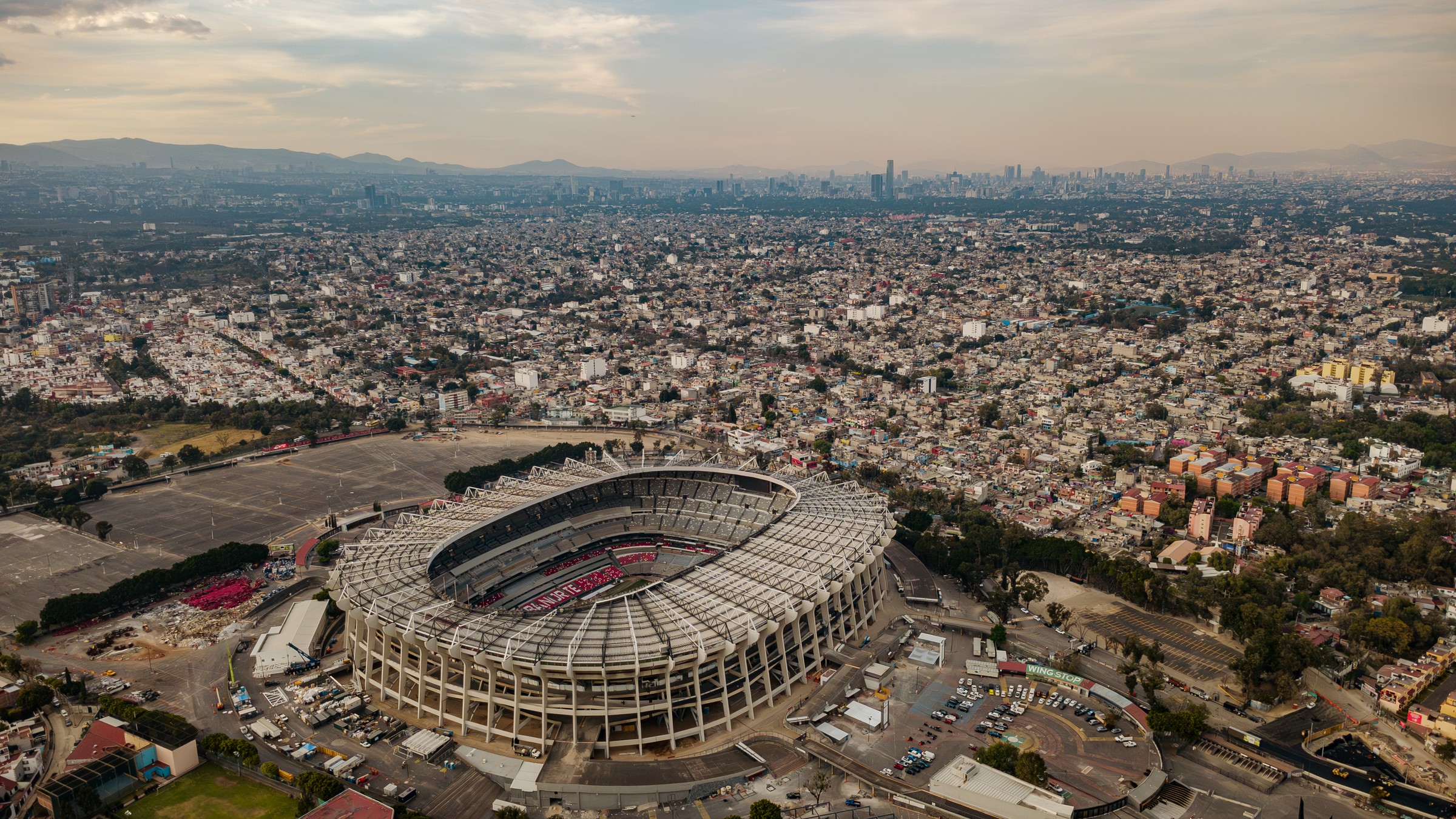
The basics first, for anyone settling in for their first World Cup of this era. The tournament runs from June 11 to July 19, 2026, across sixteen cities in the United States, Canada, and Mexico — the first World Cup co-hosted by three nations, and the first with 48 teams. It opens at Mexico City's Estadio Azteca and ends at MetLife Stadium outside New York.
The scale is the first thing you'll feel. There are 104 matches in 39 days, up from 64 in 29 — for the better part of two months, there is football almost every day, with the group stage alone running to 72 matches across twelve groups.
The shape of the road changes too. After the groups, the surviving 32 enter a Round of 32 — a whole knockout round the old format never had — so winning the tournament now takes eight matches instead of seven.
And one rule will quietly drive a lot of the drama: the eight best third-placed teams advance, so finishing third in your group is no longer the end. There's a twist for the watching fan, though — because the "best third" is judged across all twelve groups at once, a team can finish its last group game in third and then wait days to find out whether it has gone through. Some of the tournament's tensest moments will happen with nobody on the pitch.
The format, in numbers
| 2022 (32 teams) | 2026 (48 teams) | |
|---|---|---|
| Total matches | 64 | 104 |
| Groups | 8 × 4 teams | 12 × 4 teams |
| Advance from group | 16 of 32 (50%) | 32 of 48 (67%) |
| Third-place advancement | No | 8 of 12 (67%) |
| Knockout rounds | 4 (R16 → Final) | 5 (R32 → Final) |
| Matches to win it all | 7 | 8 |
| Tournament span | 29 days | ~39 days |
The headline change: two-thirds of the field advances, not half. The group stage eliminates 16 teams, not 16. Sixteen teams go home after three matches. In 2022, it was also sixteen — but that was half the field. Now it's a third.
Thirteen teams are near-certain to advance
Our model gives 13 teams a greater than 95% chance of clearing the group stage.
| Team | P(advance) |
|---|---|
| Spain | 98.9% |
| Brazil | 98.0% |
| Argentina | 97.7% |
| England | 97.7% |
| Germany | 97.6% |
| Switzerland | 95.8% |
| France | 96.5% |
| Belgium | 96.8% |
| Portugal | 95.6% |
| Mexico | 91.0% |
| Ecuador | 90.7% |
| Canada | 91.4% |
| Colombia | 92.2% |
For these teams, the group stage is a warm-up. Their real tournament starts in the Round of 32. The format essentially gives elite teams three competitive friendlies before the knockouts begin.
Under the old 32-team format, a top seed drawing a difficult group — say, a "group of death" with three strong sides — could face real elimination risk in the group stage. That structural drama is largely gone. With four teams per group and the third-place safety net, the model gives Spain a 0.3% chance of going home early. Argentina: 0.8%. Brazil: 0.7%.
The group of death, as a concept, is dead for top seeds. Only one group defies this — Group D, where the United States, Turkey, Australia, and Paraguay produce a 12.8-percentage-point spread between first and last in win-group probability. Every other group has a spread of 47 points or more.
The third-place rule changes everything for the middle of the field
The defining structural innovation of this format is the best-third-place rule: eight of twelve third-place finishers advance to the knockout stage. This is not new to football — Euro 2016 used the same mechanism with six groups — but at this scale, with twelve groups, it transforms the group stage.
Twenty-four of the forty-eight teams are most likely to finish third in their group. For half the field, the safety net is the plan.
The teams whose tournament path is most reshaped by this rule:
| Team | P(advance) with 3rd-place rule | Without the rule | Uplift |
|---|---|---|---|
| Ivory Coast | 76.3% | 31.5% | +42.1pp |
| Scotland | 67.5% | 32.6% | +39.4pp |
| Bosnia and Herzegovina | 52.9% | 18.6% | +31.6pp |
| Panama | 32.4% | 13.6% | +29.2pp |
| Egypt | 71.0% | 40.2% | +28.6pp |
| Senegal | 74.0% | 49.5% | +28.5pp |
| Algeria | 71.7% | 40.0% | +28.0pp |
| Norway | 82.8% | 57.1% | +26.0pp |
Ivory Coast's advance probability more than doubles — from 32% to 74% — because of the third-place rule. They sit in Group E with Germany, Ecuador, and Ivory Coast. Under the old format, finishing behind Germany and Ecuador meant going home. Under this format, a third-place finish likely means a Round of 32 ticket.
Scotland's story is similar. In Group C with Brazil, Croatia, and Haiti, they are heavy favourites for third — the model gives them a 54% chance of finishing third, a 25% chance of second, and just an 8% chance of winning the group. The third-place rule turns a probable group-stage exit into a probable knockout berth.
But the championship is as concentrated as ever
The format broadens participation. It does not broaden the title race.
Four teams hold 53% of the championship probability:
| Team | P(champion) |
|---|---|
| Argentina | 17.3% |
| Spain | 16.5% |
| Brazil | 9.8% |
| France | 9.0% |
The top eight hold 76%. The bottom forty share 24%.
The extra knockout round actually reinforces this concentration. A deep run now requires eight wins across 39 days instead of seven across 29. The additional match is a tax paid by every team that reaches the final — but elite squads with depth absorb it more easily than thin ones.
The confederation-level view makes the divide even starker:
| Confederation | Teams | Avg P(advance) | Avg P(champion) |
|---|---|---|---|
| CONMEBOL | 6 | 90.4% | 5.91% |
| UEFA | 16 | 83.0% | 3.53% |
| CONCACAF | 6 | 56.0% | 0.25% |
| AFC | 9 | 51.1% | 0.26% |
| CAF | 10 | 50.5% | 0.43% |
| OFC | 1 | 20.2% | 0.02% |
CONMEBOL's six teams average 90% advancement probability and nearly 6% championship probability each. CAF's ten teams average 50% advancement and 0.4% championship. The expansion gives more confederations more seats. It does not give them more realistic paths to the trophy.
Squad depth becomes a structural variable
Under the old format, a team winning the tournament played seven matches across 29 days — roughly one match every four days. Under the 48-team format, the winner plays eight matches across approximately 39 days.
One extra match sounds marginal. In context, it is not.
The tournament runs across June and July in North American venues — many in high heat and humidity. Players arriving from European clubs will have finished their domestic seasons in May, with Champions League finalists potentially playing into early June. The recovery window between the end of club season and the start of international tournament duty is, for some players, measured in days.
The teams best positioned for this are the ones with genuine two-deep squads: France can rotate Mbappé and Dembélé, Griezmann and Thuram. Spain's midfield depth — Pedri, Gavi, Olmo, Zubimendi — lets them rest players without losing quality. England, Germany, and Brazil have similar options.
The teams worst positioned are the ones that rely on a narrow core. A single injury to a key player is more likely to matter when the tournament is eight matches long than when it is seven, and the gap between the starting eleven and the reserves is wider for smaller squads.
The format creates a two-tier tournament
The clearest takeaway from the model: the 48-team format is two tournaments sharing a bracket.
The first tournament is the group stage, where 48 teams compete to be among the 32 that advance. For 13 of those teams, this is essentially a formality. For the 10 teams with less than 30% advancement probability, it is the whole tournament. For the 25 teams in between, it is genuinely uncertain — and the third-place rule is what makes most of those campaigns viable.
The second tournament is the knockout stage, where 32 teams compete for the trophy. This is where the hierarchy reasserts itself. The Round of 32 exists to filter out the third-place survivors and the weaker second-place finishers. By the quarter-finals, the field will look like it always does: the same eight to ten teams that were favoured before the draw.
The format's promise is that more nations get to play in a World Cup. That promise is kept — 48 teams is 48 teams, and four of them are debutants. The format's structural truth is that it does not meaningfully widen the set of teams that can win. It widens the audience and the spectacle. The hierarchy, as the model sees it, is intact.
Where to read more
The full tournament dashboard — all 48 teams, every group, every knockout probability — is at /tournament/. The methodology is at /docs/methodology/.
All numbers in this post are model outputs as of June 7. They are for research and educational purposes only — not betting advice, not financial advice, not recommendations to gamble. The model can be wrong. Methodology: /docs/methodology/. Full Terms of Use.