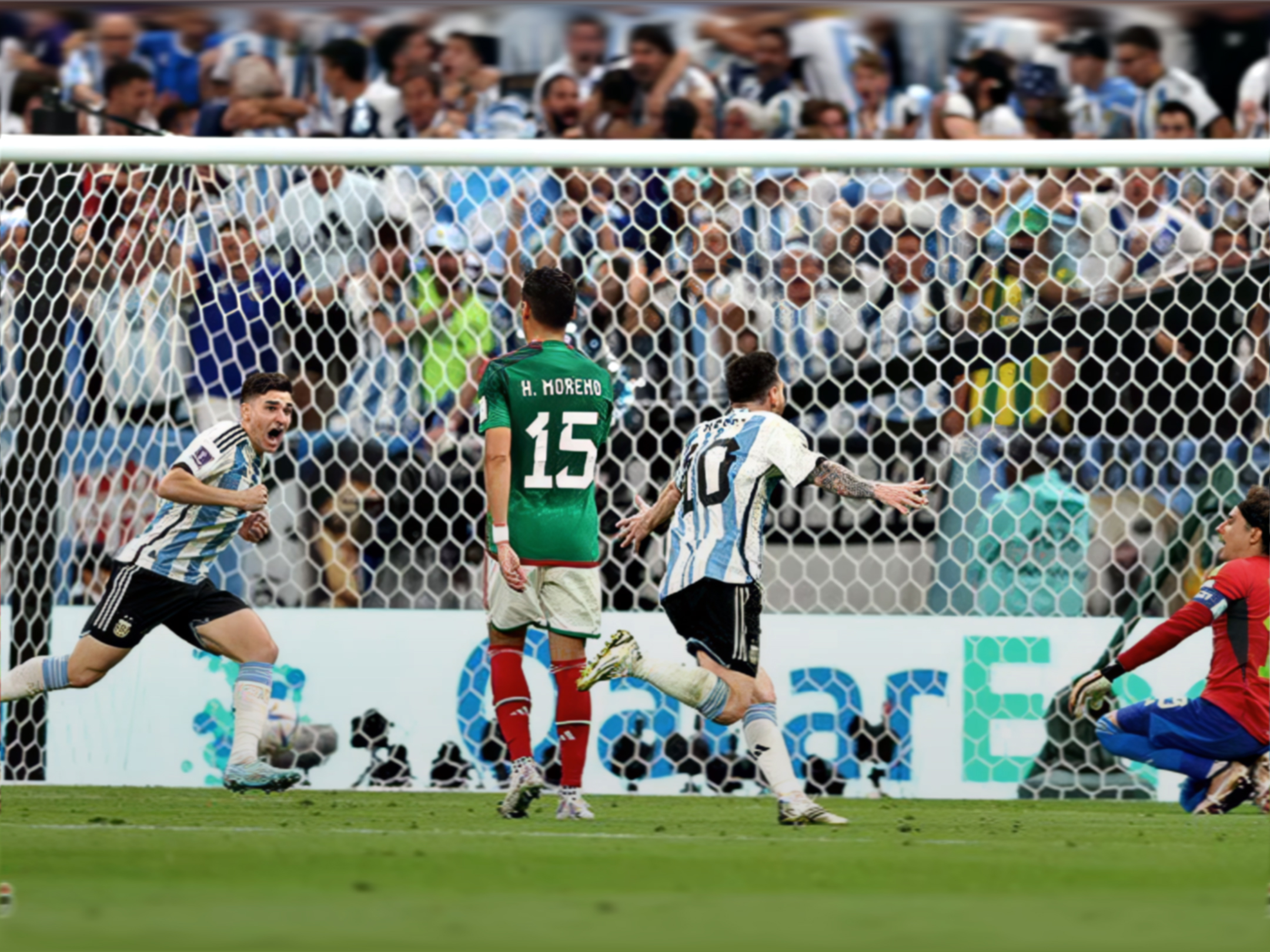
Argentina wins the 2026 World Cup 17.5% of the time in the model's tournament Monte Carlo. Spain wins it 16.9% of the time. The gap, 0.6 percentage points, is noise. In a 50,000-simulation run whose bootstrap confidence intervals span roughly four points either side of each estimate, the model considers them equally likely to win the tournament.
But it sees them as completely different teams.
Spain: the front door
Spain's probability runs through attack. Their Elo rating of 2165 is the highest in the 48-team field. The Dixon-Coles attack parameter is +1.44, the strongest in the tournament. In UEFA qualifying, Spain ranked first of 54 teams in both passing and shots on target, and third in big chances created. The model sees a team that creates volume.
The structure behind that output matters. Eight of Spain's 26 predicted-squad players come from Barcelona: a goalkeeper, two centre-backs, three midfielders, and two forwards. That's not a coincidence cluster. It's a pre-built system. Players who trained together daily under Flick for the entire 2025-26 club season arrive at the international camp with passing patterns, pressing triggers, and spatial habits already installed. In a tournament format where preparation time is measured in days, that's a structural advantage no amount of coaching can replicate from scratch.
Spain's penalty profile is unremarkable: 72% conversion, 25% save rate, both near the population average. Their probability doesn't depend on reaching shootouts. It depends on winning before they get there.
Argentina: the back door
Argentina's probability runs through the other end. Their Dixon-Coles defence parameter (+1.33) is the highest in the 48-team field, and it sits above their attack (+1.31), the reverse of Spain's shape. Across 18 CONMEBOL qualifiers they conceded the second-fewest goals per match in the confederation. The model sees a team that suffocates opponents.
The defending champions arrive with the same manager who lifted the trophy in Qatar 2022, 17 of 26 squad members from top-five European leagues, and Lionel Messi at 38 with 198 caps, almost certainly his final World Cup. The tournament pedigree is not cosmetic. It shows up in how the squad handles knockout pressure, particularly in the phase of a match where pressure becomes most binary: the penalty shootout.
The penalty factor
Argentina's penalty record is where the two paths diverge most sharply. Conversion rate: 77%. Save rate: 28%. Both numbers sit meaningfully above the population average (75% and 20%), and the save rate is the real engine. Stopping penalties is the rarer skill, the one fewer teams have, and the one that compounds most in a knockout format.
The model's counterfactual test makes the magnitude concrete. Reset Argentina's penalty rates to the population average and their win probability drops roughly 5 percentage points: in the counterfactual run, from about 20% to 15%. That means roughly one in four of Argentina's title probability comes from being elite at penalty shootouts.
Spain, by contrast, drops only about 2 percentage points in the same exercise. Their penalty rates are already close to average. Their probability is barely affected.
In a 48-team format where knockout matches run from the round of 32 onward, the penalty advantage compounds across rounds. Argentina doesn't just survive individual shootouts more often. They survive more often in each of multiple rounds, and each round they survive adds another chance at the final. The shootout isn't a tiebreaker for Argentina. It's a weapon.
The historical analogues
Both teams' nearest historical analogues carry an uncomfortable pattern.
Spain's profile is rare enough that no historical team is a close fit; the analogue engine's nearest neighbours all sit beyond the similarity threshold the site uses to display them. The nearest, for what it's worth, is Belgium at Euro 2024: a high-Elo European team with a large gap between its strength rating and group-opponent difficulty, strong recent form, and deep tournament experience. Belgium lost in the round of 16. The second-nearest is Germany at the 2018 World Cup. Germany went out in the group stage.
Argentina's analogues are much tighter fits, and they are all the same team: Brazil at the 2022 World Cup, the 2018 World Cup, and the 2015 Copa América. High-Elo CONMEBOL sides with strong recent form, top-seeded group positions, and rosters packed with European-league starters. All three exited at the quarter-final stage.
These analogues don't predict the outcome. The model already incorporates the statistical profiles that generate them, and the probabilities reflect that. But they illustrate a historical regularity worth naming: being the strongest team in the field, by a clear margin, tends to buy less than intuition suggests. The advantage exists. It's real. It's just smaller than a 99% group-advance rate makes it feel.
The question
Argentina 17.5%. Spain 16.9%.
One wins through the back door: a defensive wall, a veteran core, and a penalty record that accounts for roughly a quarter of its title probability. The other wins through the front: attacking volume, creative density, a system imported from Barcelona.
Both teams' historical analogues exited earlier than their probability implied. Both arrive at this tournament as the model's top two.
Which pattern breaks first?
All numbers in this post are model outputs as of the June 11 snapshot. They are for research and educational purposes only: not betting advice, not financial advice, not recommendations to gamble. The model can be wrong. Methodology: /docs/methodology/. Full Terms of Use.