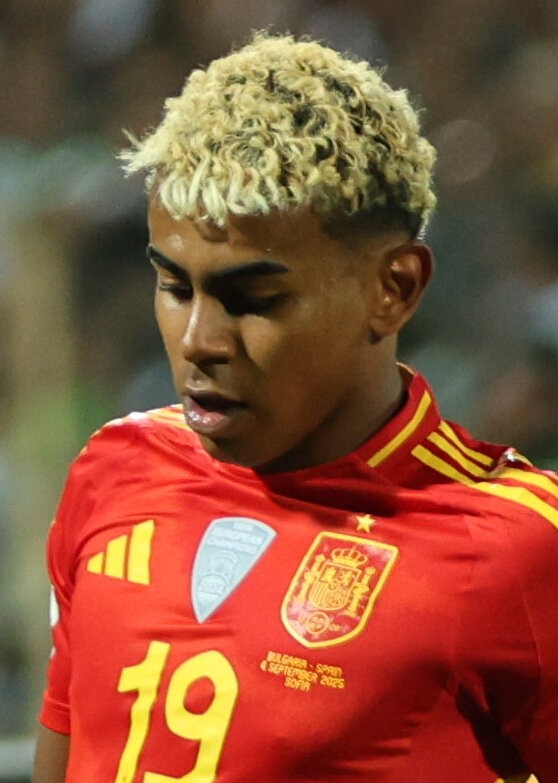
Spain put four past Saudi Arabia in half an hour. Egypt came back from 1-0 down at the break to beat New Zealand 3-1. Their first World Cup win. Ever. And the draw groups held form: Belgium drew again, Cape Verde drew again.
June 21: the scorecard
| Match | Result | P(result) | Brier |
|---|---|---|---|
| Spain vs Saudi Arabia | 4-0 | 84.9% | 0.039 |
| Belgium vs Iran | 0-0 | 24.8% | 0.900 |
| Cape Verde vs Uruguay | 2-2 | 21.4% | 1.151 |
| Egypt vs New Zealand | 3-1 | 53.6% | 0.328 |
Mean Brier: 0.605. Two strong calls, two draw misses. Running mean through 40 matches: 0.599 (was 0.598 through 36).
Spain 4-0 Saudi Arabia: the model's best call
The model had Spain at 84.9%. Spain scored three by half-time.
Lamine Yamal opened in the 10th minute, his first World Cup goal, the eighth-youngest scorer in men's World Cup history. Mikel Oyarzabal added two in quick succession. Hassan Al-Tambakti's own goal made it four after the break. Ferran Torres had a fifth ruled out for offside.
The 0-0 against Cape Verde on Matchday 1 looked like a warning. The model said it was noise. Spain's Elo (2165, ranked 1st) against Saudi Arabia's (1568, ranked 71st) meant a 597-point quality gap. One shut-out does not erase that.
Brier: 0.039. The lowest single-match penalty of the entire tournament. The model was 84.9% confident and the result came in 3-0 before half-time.
Spain seal a Round of 32 place with a match to spare. Group H has a clear leader.
Belgium 0-0 Iran: twenty-three shots, nothing
Belgium had 23 shots. An expected-goals count of 1.8. A red card to Nathan Ngoy in the 66th minute. And zero goals.
Alireza Beiranvand made seven saves. Belgium's most shots without scoring in a World Cup match since 1994.
The model had Belgium at 53.7%, which was already a significant drop from the 60.4% they carried into Matchday 1. After drawing Egypt 1-1, Belgium's Elo could not absorb another non-win without consequence. Two matches, two draws, zero goals in open play.
Kevin De Bruyne, Romelu Lukaku, Thibaut Courtois. If this is the last World Cup for Belgium's golden generation, they have two points from two matches and a final group game to rescue the campaign. Iran, playing through travel restrictions and visa complications, have the same two points. Beiranvand is the reason.
Brier: 0.900. The model predicted a Belgian win; the result was a draw. The draw probability of 24.8% was low, but the model has been wrong on draws all tournament. Belgium and Iran are closer than Belgium's name suggests.
Cape Verde 2-2 Uruguay: they will not lose
Kevin Pina scored from 30 yards. A free kick that opened the scoring against a two-time World Cup champion. Cape Verde led Uruguay.
Maxi Araujo and Agustin Canobbio turned it around. Uruguay went 2-1 ahead. The model's prediction looked safe: 72.8% Uruguay.
Then Helio Varela came off the bench. Fernando Muslera rushed out. Varela chipped the ball over his head into an empty net. 2-2.
Cape Verde: 0 wins, 0 losses. Drew Spain 0-0. Drew Uruguay 2-2. Two points from two matches against teams ranked 1st and 15th in the world. The combined Elo gap across those two opponents is over 1,000 points. They do not care.
Brier: 1.151. Another heavy draw penalty. The model gave the draw a 21.4% chance. Cape Verde continue to sit in the space the model cannot see: a small nation with nothing to lose and the discipline to take a point from anyone.
Egypt 3-1 New Zealand: history in Vancouver
Egypt trailed 1-0 at the break. New Zealand led, and for 45 minutes, it looked like the draw-group pattern would break the wrong way.
Then the second half happened. Mohamed Salah equalised. Mostafa Zico put Egypt ahead. Trezeguet added a third. Three unanswered goals in the second half. Egypt's first World Cup win in their history.
Egypt appeared in 1934, 1990, and 2018. They lost or drew every match. Three tournaments, zero victories, until Sunday evening in Vancouver.
The model had Egypt at 53.6%. It called the direction right, though the margin (3-1) exceeded the expected-goals projection of 1.23 vs 0.49. Salah's quality made the difference. The model sees aggregate ratings; it does not see individual brilliance at turning points.
Brier: 0.328. Solid. Egypt top Group G on 4 points. New Zealand sit on 1.
The day's pattern: Spain proves the model, everyone else tests it
One match went exactly as the model projected: Spain 4-0, Brier 0.039. One match went in the right direction with a larger margin: Egypt 3-1, Brier 0.328. Two matches produced draws the model rated below 25%: Brier 0.900 and 1.151.
Groups G and H have now played eight matches. Six were draws. Only Spain vs Saudi Arabia (4-0) and Egypt vs New Zealand (3-1) produced winners. The model's framework, built on Elo quality gaps, correctly identifies the two dominant results but underestimates the frequency of draws between closely-matched mid-tier teams.
Draw count through 40 matches: 13 (32.5%). The model's average predicted draw probability sits around 24%. The gap persists. Whether this reflects a structural model weakness or a World Cup-specific pattern that will revert by the knockout round remains the tournament's open statistical question.
June 22: the decisive groups
Groups I and J return for Matchday 2. These groups are the opposite of the draw groups. Matchday 1 produced four decisive results, all home wins, all by multiple goals:
| Matchday 1 | Group | Result |
|---|---|---|
| France vs Senegal | I | 3-1 |
| Iraq vs Norway | I | 1-4 |
| Argentina vs Algeria | J | 3-0 |
| Austria vs Jordan | J | 3-1 |
Four matches, four winners, 14 goals scored. No draws. Groups G and H produced four draws and 10 goals. The contrast is striking.
| Match | Group | Model H/D/A |
|---|---|---|
| Argentina vs Austria | J | 56.1 / 28.0 / 15.9 |
| France vs Iraq | I | 70.5 / 21.9 / 7.5 |
| Senegal vs Norway | I | 32.3 / 28.8 / 39.0 |
| Algeria vs Jordan | J | 52.3 / 24.8 / 22.9 |
Argentina vs Austria: the table decider
Both won convincingly on Matchday 1. Argentina beat Algeria 3-0 (Messi hat trick). Austria beat Jordan 3-1. Both sit on 3 points. This match decides who leads Group J into the final matchday.
Argentina's Elo (2113, ranked 2nd) gives them the edge. Austria's (1827, ranked 23rd) represents a 286-point gap. The model reads that as 56.1% Argentina, 15.9% Austria, 28.0% draw.
The draw probability at 28% is the highest on today's card. Two well-organised teams that both proved on Matchday 1 they can score and defend. Argentina are favourites, but this is closer than France vs Iraq.
Expected goals: 1.59 vs 0.65. The model expects a low-scoring match with Argentina controlling territory. Whether Austria can replicate the defensive structure that frustrated better-ranked opponents in qualifying is the question.
France vs Iraq: the largest gap on the card
France (Elo 2081, ranked 3rd) vs Iraq (Elo 1607, ranked 63rd). A 474-point Elo gap, the widest on today's schedule.
France beat Senegal 3-1 on Matchday 1. Iraq lost 1-4 to Norway. The model gives France 70.5%, the highest single-team probability on the card. Expected goals: 2.26 vs 0.49.
Iraq need a result to stay alive in Group I. France need a win to guarantee qualification with a match to spare. The model sees this as close to settled.
Senegal vs Norway: the tightest call
Senegal (Elo 1878, ranked 17th) lost 1-3 to France. Norway (Elo 1912, ranked 12th) beat Iraq 4-1. Senegal sit on zero points. Norway sit on three.
The model has Norway at 39.0%, Senegal at 32.3%, draw at 28.8%. The tightest three-way split on the card. Just 34 Elo points separate them. Expected goals: 1.03 vs 1.16.
This is a must-win for Senegal. A second loss almost certainly eliminates them. Norway, with 3 points already, can afford a draw but would prefer 6 points heading into the final match. The model sees this as genuinely open.
Algeria vs Jordan: survival
Algeria (Elo 1743, ranked 35th) lost 0-3 to Argentina. Jordan (Elo 1690, ranked 50th) lost 1-3 to Austria. Both teams enter Matchday 2 with zero points and negative goal differences.
The model gives Algeria 52.3%, Jordan 22.9%, draw 24.8%. A 53-point Elo gap puts Algeria slightly ahead. Expected goals: 2.00 vs 0.77.
The loser of this match faces Argentina or Austria on the final matchday needing a result. For both teams, this is the winnable fixture on the schedule. For one of them, it will be the last match of the tournament.
Calibration through 40 matches
Running mean Brier: 0.599. Uniform baseline: 0.667. The model continues to outperform random guessing. The June 21 day average (0.605) landed almost exactly on the running mean, so the tournament-level number barely moved.
The story of the model through 40 matches: strong on heavy favourites (Spain, Germany, Netherlands), solid on moderate favourites (Egypt, Japan), and persistently exposed on draws. Thirteen draws from 40 matches (32.5%) against a model average prediction of around 24%. The draw gap is the single largest source of Brier penalty in the tournament.
All probabilities are frozen pre-match model outputs, locked before kickoff. The model publishes probabilities, not recommendations. Methodology: /docs/methodology/. Track record: /accuracy/. Full Terms of Use.