Yesterday we led the preview with "the model flips the favourite." Panama at 46.6%, the widest disagreement of the tournament, the headline call of the entire group stage so far.
Ghana won 1-0. Caleb Yirenkyi scored in the 95th minute.
June 17: the scorecard
| Match | Result | P(result) | Brier |
|---|---|---|---|
| Portugal vs DR Congo | 1-1 | 22.0% | 1.108 |
| England vs Croatia | 4-2 | 50.3% | 0.371 |
| Ghana vs Panama | 1-0 | 26.3% | 0.834 |
| Uzbekistan vs Colombia | 1-3 | 61.8% | 0.228 |
Mean Brier: 0.635. Uniform baseline: 0.667. The model barely scraped under random, dragged down by two bad misses.
The Panama reckoning
The model rated Ghana at 26.3%. That is the lowest win probability assigned to any actual winner in this tournament. Not just wrong directionally (Panama was the model's favourite at 44.8%), but wrong with conviction.
The Elo gap between Panama (1737) and Ghana (1503) drove the call. The ensemble averaged out to a Panama lean. Consensus had Ghana as the favourite at 41.5%. Consensus was right.
The honest read: when a model's internal components disagree this sharply (the Elo model gave Panama 68.4%, Dixon-Coles gave Ghana 38.6%), the ensemble average can paper over genuine uncertainty. The model smoothed what should have stayed rough. A 95th-minute winner only makes the point more dramatic, but the miss was baked in before kickoff.
DR Congo's historic point
Yoane Wissa equalized in the 5th minute of stoppage time. DR Congo's first ever World Cup goal, and their first ever point. We flagged Wissa in the preview as the most likely goalscorer on the pitch at 10.6%, ahead of Ronaldo at 9.8%. That call landed.
Portugal at 75.2% (the frozen model number) produced a Brier of 1.108, the worst single-match score of the tournament. Ronaldo's sixth World Cup opened with frustration, not a record.
Draw number nine from 24 matches. The rate sits at 37.5%, compressing from the 50% peak but still well above the model's ~25% average.
England 4-2 Croatia: entertainment, not a coin flip
The model said 50.3%, barely above even. England won by two clear goals in a six-goal match. Kane scored twice before halftime. Croatia twice clawed back through Baturina and Musa. Then Bellingham and Rashford pulled away.
The model was directionally right but massively underestimated the gap. When a 50.3% call produces a 4-2, the honest assessment is that the model saw a close match and reality delivered a decisive one. Brier: 0.371. Decent but not sharp.
Colombia 3-1 Uzbekistan
The cleanest result of the day. Colombia won comfortably over the World Cup debutants. The model's 61.8% was correct directionally, though consensus (around 71.5%) was closer to the truth. The pattern continues: the model underprices favourites, and when favourites deliver, consensus looks better.
Brier: 0.228. The day's best score, and the only match where the model performed well.
Calibration through 24 matches
Running mean Brier: 0.659. The uniform baseline is 0.667. The model is barely distinguishing itself from a know-nothing guess across the full sample.
The shape is becoming clear. On days when favourites deliver (June 16: mean Brier 0.197), the model looks excellent. On days when draws and upsets arrive (June 15: four draws, June 17: two heavy misses), the model struggles. The model's draw calibration remains the weakest link: it assigns roughly the same draw probability (~22-24%) whether or not the match actually draws.
Nine draws from 24 matches. 37.5%. The model's average predicted draw probability is 23%. That gap is not closing.
June 18: Matchday 2 begins
The tournament shifts gears. For the first time, groups revisit. Teams that won on Matchday 1 face each other. Teams that lost face elimination. And today's card features the most extreme travel asymmetry of the group stage.
The hosts flex
Two numbers tell the story of today's card.
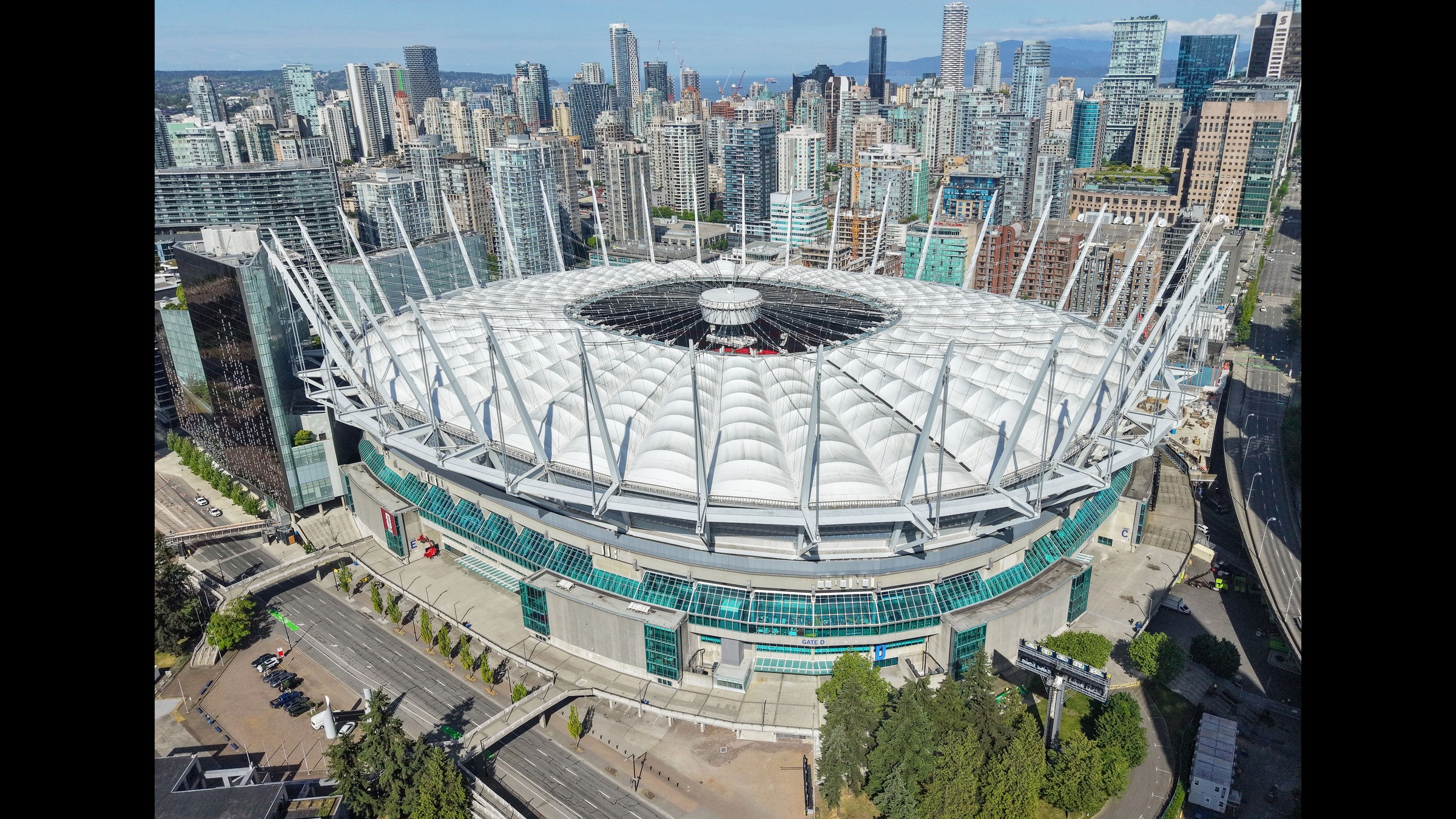
Canada traveled 0.9 kilometres to BC Place in Vancouver. They are based at BC Place. Qatar traveled 11,697 kilometres with a ten-hour timezone shift to reach the same stadium.
Mexico traveled 473 kilometres from Mexico City to Estadio Akron in Guadalajara. South Korea traveled 11,732 kilometres with a fifteen-hour timezone shift.
These are the second and third largest travel gaps in the entire 72-match group stage. Only the opening match (Mexico vs South Africa, a 14,091km gap) was more lopsided. Two of the three most extreme travel asymmetries in the tournament, on the same day.
Through 24 matches, the less-traveled side has avoided defeat in 70% of fixtures. The away long-haul side has yet to win when the gap exceeds 6,000 kilometres.
The model already accounts for travel. These probabilities are not naive. But the visual is worth holding: one team walks to the stadium, the other crosses the planet.
| Match | Group | Model H/D/A | Travel gap |
|---|---|---|---|
| South Africa vs Czech Republic | A | 16.5 / 24.8 / 58.7 | 5,465km (CZE closer) |
| Bosnia vs Switzerland | B | 9.3 / 21.9 / 68.8 | 712km (roughly equal) |
| Canada vs Qatar | B | 67.5 / 22.3 / 10.2 | 11,696km (CAN home) |
| Mexico vs South Korea | A | 45.3 / 27.4 / 27.2 | 11,259km (MEX home) |
Mexico vs South Korea: the model shrugs
The model rates Mexico at 45.3%, South Korea at 27.2%, draw at 27.4%. A three-way split. Despite Mexico's massive home advantage (473km vs 11,732km, zero timezone shift vs fifteen hours), the model barely has a view.
The reason: these two teams met nine months ago, in a September 2025 friendly, and drew. The Elo gap is only 108 points (Mexico 1860, South Korea 1752), the narrowest on today's card. Korea's recent trajectory has been sliding (from a peak of 1905 to 1872), while Mexico rebuilt under Javier Aguirre (from 1874 to 1967 and back to 1860). The trajectories are crossing.
The tactical contrast is textbook. Mexico are high-press (PPDA 16.1, possession 0.55). Korea are counter-attackers (possession 0.44, vertical buildup). Korea rank higher in final-third-entry efficiency: they are dangerous with limited possession. Son Heung-min hunting transitions behind Mexico's high defensive line is the image that defines this match.
Son carries a 12.4% match scoring probability, the highest on today's card, and is Korea's penalty taker. He flew 11,732 kilometres and shifted 15 timezone hours to face a crowd at Estadio Akron that will be overwhelmingly Mexican. Raúl Jiménez (8.6%, Mexico's penalty taker) has the shorter commute.
Both coaches were appointed in January 2024. Aguirre is managing Mexico at a World Cup for the third time (2002, 2010, 2026). Hong Myung-bo captained the South Korea side that reached the 2002 World Cup semifinals. Two men whose World Cup histories run deep.
Both teams won on Matchday 1. The winner here is one foot in the knockouts.
Canada vs Qatar: 0.9 kilometres
The model rates Canada at 67.5%. This is the widest favourite-lean on today's card, and the travel data explains why. Canada traveled 0.9km. This is not a rounding error. BC Place is their base. Qatar crossed 11,697km with a ten-hour timezone shift.
Canada's arc makes the home advantage story richer. In 2014, Canada sat at roughly 1570 Elo, a CONCACAF also-ran. They climbed through qualifying (beating the USA, Mexico, El Salvador) to a peak of 1966 in February 2022. They sit at 1784 today. This is not a diplomatic invitation to a home tournament. They earned this.
Jonathan David is at Juventus. Thirty-nine goals in 75 caps. The model's fourth-ranked anytime scorer in the entire tournament, with a 44.9% probability of scoring at some point in the group stage. He is Canada's penalty taker. Alphonso Davies (Bayern Munich) provides the pace on the flank. Jesse Marsch, an American, coaches the squad.
Qatar will make this difficult. Their tactical fingerprint is "low-block" (PPDA 35.0, the lowest pressing intensity in the group, minimal possession). They will absorb, frustrate, and wait. Julen Lopetegui, the Spain manager who was fired the day before the 2018 World Cup for agreeing to join Real Madrid, coaches this side. He knows how to set up a defensive shape.
And Qatar have already proven resilient. They drew Switzerland 1-1 on Matchday 1 despite a 464-point Elo gap, the biggest upset-by-Elo of the group stage. The model rated Switzerland at 79.7% in that match. Qatar earned a point anyway.
The model says 67.5% Canada. But Qatar just proved that model confidence means less than it should.
Bosnia vs Switzerland: Džeko's farewell, Switzerland's credibility
The model gives Switzerland 68.8%. After the Qatar draw, that number deserves a question mark.
Switzerland entered this tournament flying. Their Elo peaked at 1964 after beating Sweden twice in qualifying. Murat Yakin has been in charge since 2021, the longest-tenured Swiss manager in recent memory. They were supposed to be comfortable Group B favourites.
Then Qatar happened. A 1-1 draw against the lowest-rated team in their group (Elo 1425 vs 1889). The model assigned 79.7% to a Swiss win. The resulting Brier penalty (1.108) was one of the heaviest single-match hits of the tournament. Something was off. Was it the travel (9,567km to Vancouver)? Was it Qatar's low-block frustrating the Swiss buildup? Or is Switzerland simply not as strong as their Elo suggests?
Today they face Bosnia in Los Angeles (SoFi Stadium). The travel is roughly equal: Bosnia 10,279km, Switzerland 9,567km. No home advantage for either side. Both teams drew on Matchday 1 (Bosnia 1-1 with Canada, Switzerland 1-1 with Qatar). Both sit on one point.
Edin Džeko is 40 years old. He has 148 caps and 73 goals for Bosnia, both all-time records by a wide margin. He plays for Schalke 04. This is Bosnia's second ever World Cup. If they lose, it could be his last World Cup match. Sergej Barbarez, himself a legendary Bosnian striker, coaches the side.
Both teams are tactically passive. Switzerland are "pragmatic" (possession 0.50, mid-band on every axis). Bosnia are "balanced" (possession 0.49). Two low-tempo sides. This is the stylistic profile that produces exactly what this tournament keeps producing: draws. The model assigns 21.9% to a draw. The tournament's observed draw rate is 37.5%.
South Africa vs Czech Republic: the elimination match
Both lost on Matchday 1. South Africa fell 0-2 to Mexico. Czech Republic lost 1-2 to South Korea. The loser today is almost certainly eliminated from the tournament.
The model rates Czech Republic at 58.7%. Both teams traveled long distances to Atlanta (South Africa 13,313km, Czech Republic 7,848km), though neither has anything resembling home advantage.
Czech Republic are "counter-attackers" (possession 0.45, vertical buildup). Patrik Schick leads their attack at 5.9% match scoring probability. South Africa are "balanced" with no dominant tactical identity. Lyle Foster (2.9%) is their primary threat.
The coaching contrast is notable. Hugo Broos has managed South Africa since 2021, the longest tenure on today's card. Miroslav Koubek was appointed to the Czech Republic job in 2025.
Lower glamour, higher stakes. The group stage gets real when there is nowhere left to hide.
The draws question, continued
Nine draws from 24 matches: 37.5%. The model's average predicted draw probability for today's four matches: 24.1%. That implies roughly one draw from today's card.
The model has not shown the ability to discriminate between matches that draw and matches that do not. Its average predicted draw probability on actual draws (22.2%) is essentially identical to its average on non-draws (23.9%). It assigns the same draw likelihood regardless of outcome.
If this pattern holds, the model will again undercount draws. Mexico vs South Korea (27.4% draw probability) is the most draw-prone fixture on paper, and the September 2025 friendly between the same teams ended in a draw.
All probabilities are frozen pre-match model outputs, locked before kickoff. The model publishes probabilities, not recommendations. Methodology: /docs/methodology/. Track record: /accuracy/. Full Terms of Use.