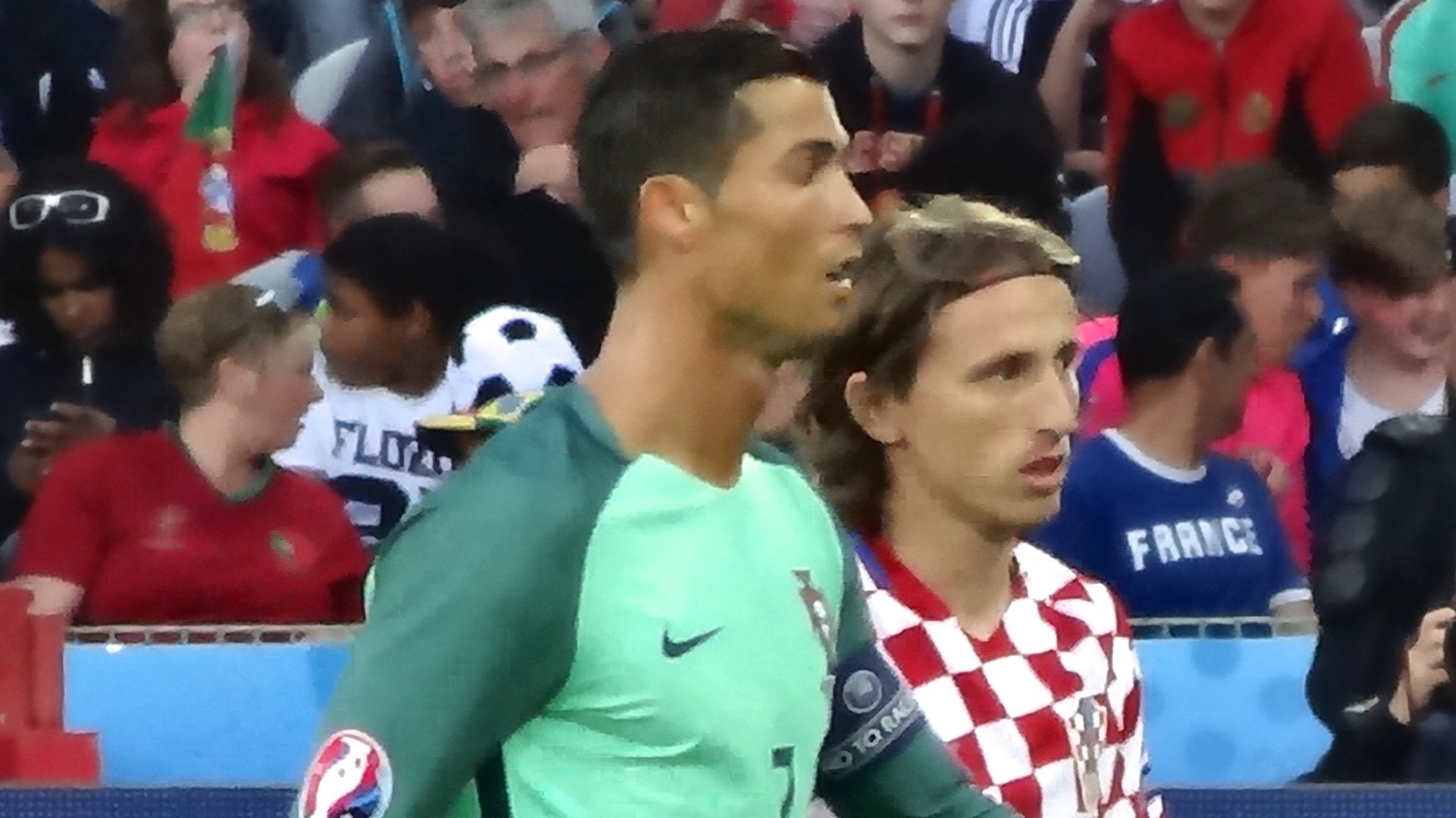
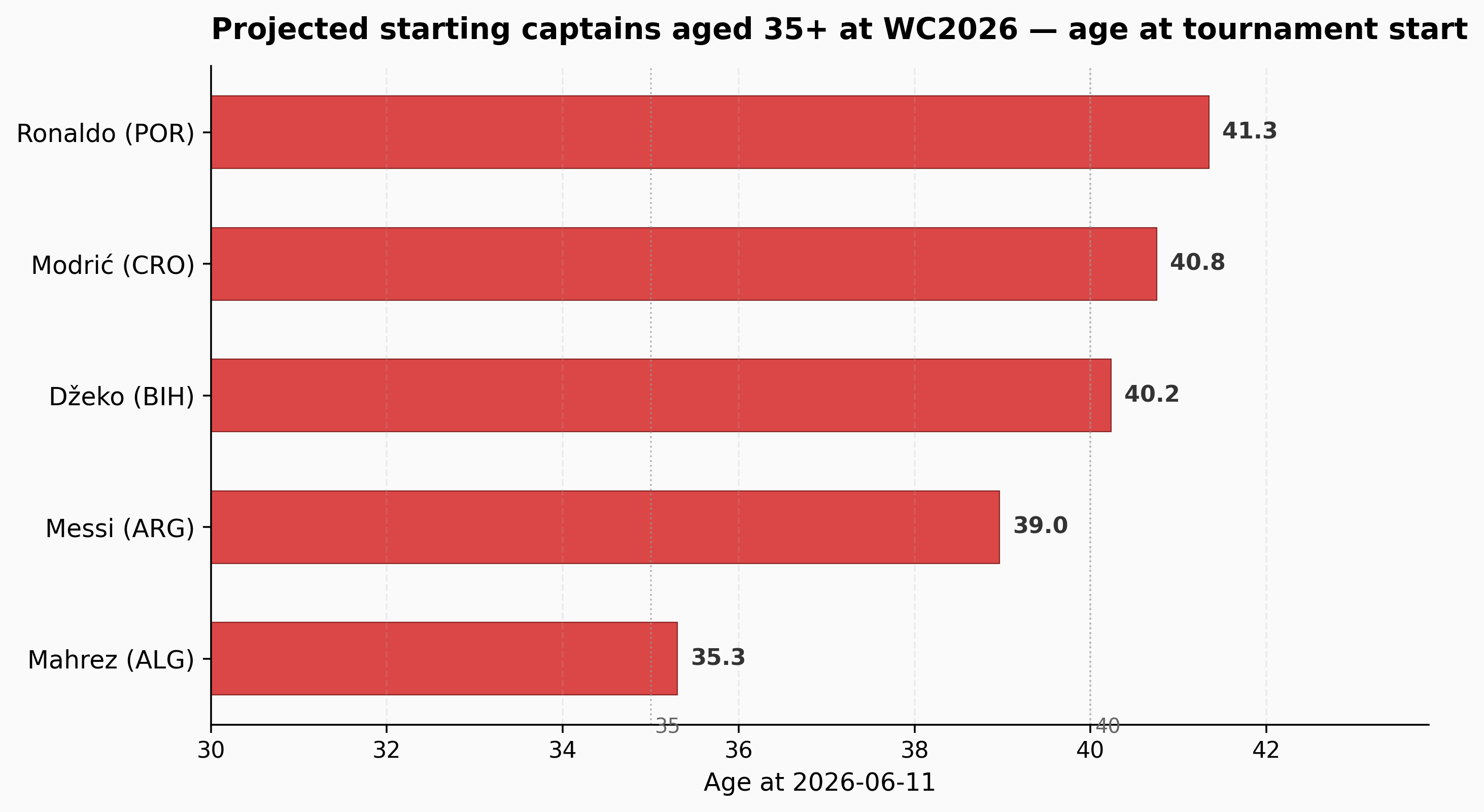
Cristiano Ronaldo will captain Portugal at 41 years old. He's not even the oldest projected starter in the tournament — Luka Modrić and Edin Dzeko are both 40 and older in playing days. Five projected starting captains at WC2026 are 35 or older at their team's opening match, and for four of them this is almost certainly the last World Cup.
The list:
| Captain | Age at opener | Team | Model's group-stage advance probability |
|---|---|---|---|
| Cristiano Ronaldo | 41 | Portugal | 95.6% |
| Luka Modrić | 40 | Croatia | 90.1% |
| Edin Dzeko | 40 | Bosnia | 52.9% |
| Lionel Messi | 38 (turns 39 mid-tournament) | Argentina | 97.7% |
| Riyad Mahrez | 35 | Algeria | 71.7% |
Ages are computed against each team's first match, with openers between 11 and 17 June 2026. Messi turns 39 on 24 June. He'll be 38 against Algeria on 16 June and 39 against Argentina's later Group J opponents.
Why this is the last one for most
The 2030 World Cup kicks off in summer 2030. Four years from now, each of these five captains will be:
- Ronaldo: 45.
- Modrić: 44.
- Dzeko: 44.
- Messi: 43.
- Mahrez: 39.
The oldest field player ever to play in a World Cup was Roger Milla at 42, in 1994. The oldest goalkeeper was Essam El-Hadary at 45, in 2018. Neither precedent extends to a starting captain who has to play sixty-plus minutes in a knockout match. For four of these five, WC2026 is the last cycle in which they can plausibly start games for their country in a major tournament.
Mahrez is the exception. He'll be 39 at WC2030, the same age Modrić is at WC2026 and Pepe was when Portugal exited the 2022 World Cup. A 39-year-old starting attacker at a World Cup is unusual but not unprecedented.
What the model gives each team
How many matches each captain plays depends on their team's path. The model's view, computed from 50,000 bracket simulations of the current Elo state:
Argentina (Messi). Highest-probability team after Spain. 97.7% to advance, 67.8% to reach R16, 53.4% to reach the quarter-finals, 15.8% to win the tournament. Of the five, Messi is the most likely to play deep into the bracket. Up to seven matches, potentially a final.
Portugal (Ronaldo). 95.6% to advance, 71.3% to reach R16, 47.8% to reach the quarter-finals, 9.0% to win. Four-to-five matches most likely.
Croatia (Modrić). 90.1% to advance, 45.8% to reach R16, 22.8% to reach the quarter-finals, 1.5% to win. Three-to-four matches most likely. Croatia made the 2018 final and the 2022 semi-final under broadly the same generation that's still showing up; a third consecutive deep run is rare but the historical priors are now non-zero.
Algeria (Mahrez). 71.7% to advance from a group with Argentina, Austria, and Jordan; from there, 23.8% to reach R16. Three matches most likely.
Bosnia (Dzeko). Just qualified through a playoff against Italy, their first World Cup since 2014. 52.9% to advance from a group with Canada, Qatar, and Switzerland; 16.2% to reach R16. Three matches most likely.
Where each of them currently plays
Each of the five has stayed in top-level club football this season, which is what's keeping them international-relevant:
- Ronaldo is at Al-Nassr in Saudi Arabia, where he's been first-choice since 2023.
- Modrić signed for AC Milan in summer 2025 after thirteen seasons at Real Madrid.
- Dzeko is in his third season at Fenerbahçe.
- Messi is at Inter Miami, where he won the 2024 Supporters' Shield and finished that season as MLS top scorer. MLS form is heavily discounted in international football discourse; the goals are still going in.
- Mahrez is at Al-Ahli in Saudi Arabia, his third season there.
None of them have been managed out of starting roles by their clubs. None of them have been managed out of starting roles by their national teams either. The decay is real and it is happening, and it has not yet hit the point where managers can ignore them.
Where to look during the tournament
For each of the five, the group-stage opener is the one match they are guaranteed to play. After that, every subsequent fixture depends on results.
The most meaningful viewing window is the first match. Argentina vs Algeria on matchday 1 puts Messi against Mahrez directly: the model's second-highest-probability tournament winner against a CAF top-tier side, with two captains aged 38 and 35. It is the only fixture at this World Cup that features two of these five captains on opposite teams.
The second viewing window is the quarter-finals. Argentina (53.2%) and Portugal (44.4%) are most likely to reach that stage; Croatia (27.1%) is plausible. Bosnia (3.5%) and Algeria (6.9%) are unlikely to make it. The quarter-finals are roughly where the last competitive World Cup match for some of these players will land.
After the tournament we'll publish a per-player retrospective: minutes played, contribution metrics, and how each performance compared with what the age curves predicted. Subscribe to get the retrospective in your inbox.
All numbers in this post are model outputs (per-team probabilities from bracket_mc.py simulations) and verifiable public data (ages, clubs, club statistics). They are for research and educational purposes only — not betting advice, not financial advice, not recommendations to gamble. Methodology: /docs/research-plan/. Full Terms of Use.