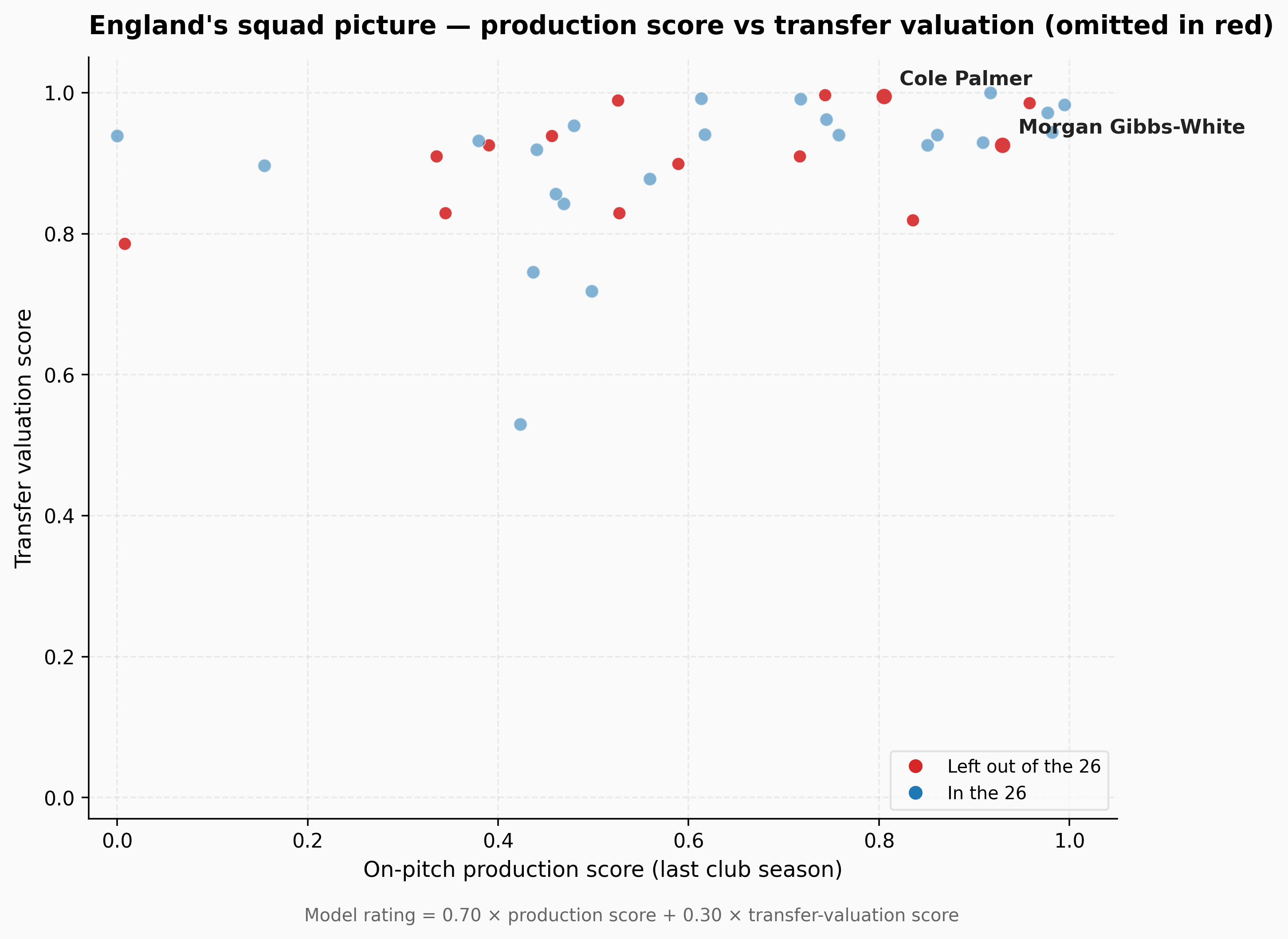
This piece is a snapshot from England's squad-announcement week (late May 2026). The model ratings below are built on 2025-26 club-season form — the season Thomas Tuchel selected on. The model refreshes as new matches land, so the live player pages will keep moving.
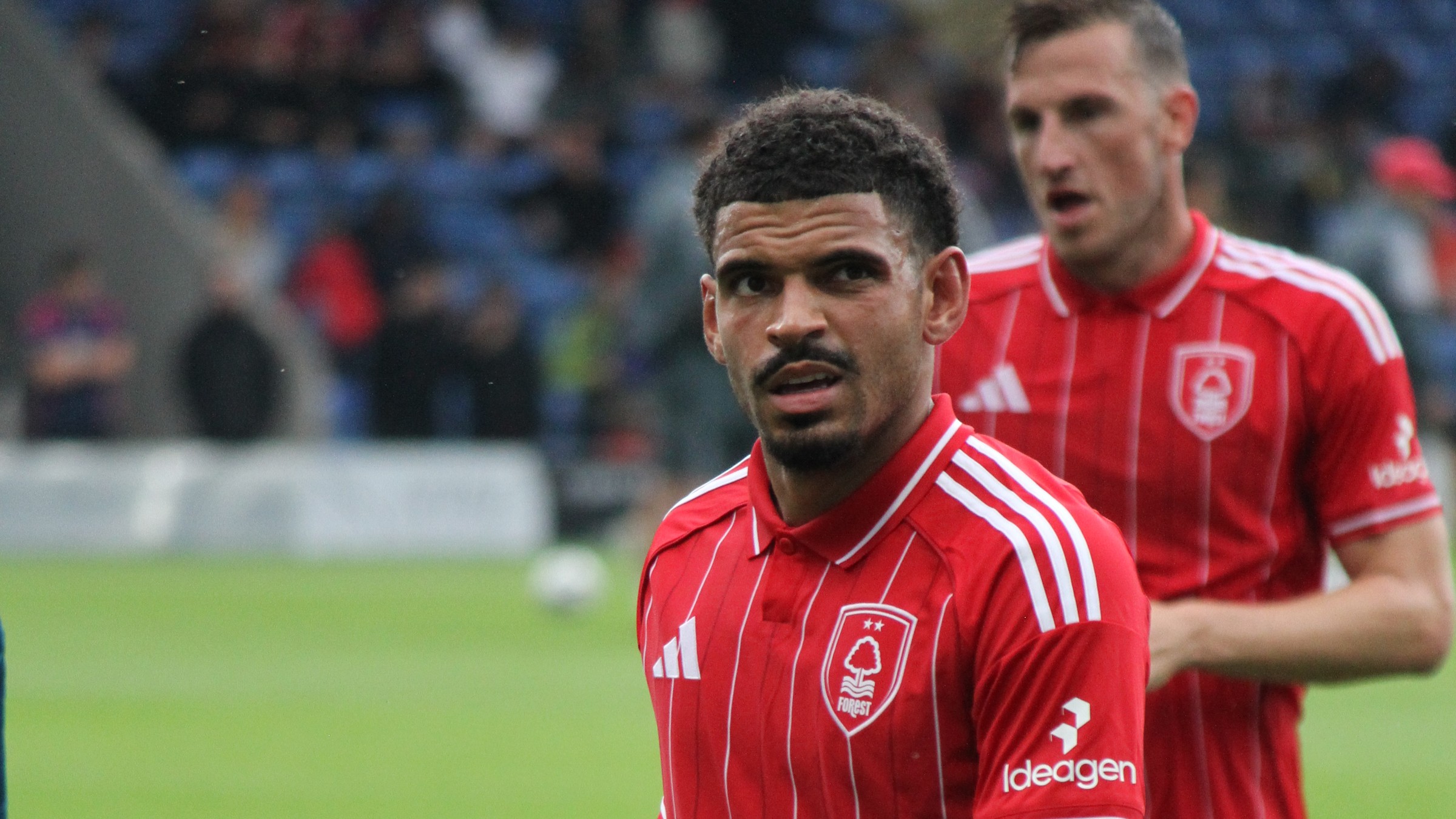
Morgan Gibbs-White has spent most of his career being told he isn't quite good enough for this level. This season, he answered: 15 Premier League goals, top scorer at Nottingham Forest, a run to a European semi-final carried in large part by him. It was, by some distance, the best season of his life.
So when Thomas Tuchel named England's 26 for the 2026 World Cup and Gibbs-White wasn't in it, the obvious question was: why was he the one left behind? The outrage that followed never really asked. It had two other names — Cole Palmer and Phil Foden, both stars, both off down years — and it left Gibbs-White almost untouched, a footnote to someone else's story.
We think that's the wrong story. Reading the 2025-26 season Tuchel actually selected on, our model is calm about the two omissions that drew the noise — and the one it would most question is the one nobody made a fuss about.
How the rating works
Every player carries a composite rating between 0 and 1, built from two inputs:
- a production score from the 2025-26 club season — non-penalty expected goals, expected assists, goals and assists per 90, weighted by position, and
- a valuation score from transfer-market data.
The composite is 0.70 × production + 0.30 × valuation. The pitch is weighted more than twice as heavily as the price tag, deliberately: a transfer valuation is slow to move and reputation-laden, while this season's output is the freshest signal of form.
By that measure, England's highest-rated eligible player is Harry Kane (0.99), and he's going. So are the next names on the list. The story is in who's missing — and which of the missing the data actually argues for.
Palmer and Foden: the omissions the model isn't shocked by
Cole Palmer sits at #13 (0.86) — well down on the player who topped this board a season ago. There's a plain reason. His 2025-26 was disrupted by injury: a groin problem and then a broken toe cost him around 19 games and most of his rhythm, and he started only about half of Chelsea's league fixtures (SI, Yahoo). The model reads form, and Palmer's form this season was interrupted. His omission lines up with a disrupted year rather than defying the numbers.
Phil Foden is lower still — #26 (0.67), a quiet season by his standards, and a production score the model has had below his peers for a while.
So the two omissions that drew the outrage are, on this season's data, among the least surprising on the list.
The snub the model would actually question
The three omitted players the model rates above him each have their own explanation: Levi Colwill (#4) was left out as too soon back from a serious knee injury, Ben White's (#5) absence is its own long-running story, and Kyle Walker (#8) is a 36-year-old defender well past his peak. Set those aside and the omission whose season is an argument for him, not against, is Morgan Gibbs-White (#9, 0.93).
Unlike Palmer's, his season is the argument for him, not against. The 15 league goals were a career high and made him Forest's top scorer; 18 in all competitions dragged the club to a European semi-final, with the winner against Porto and a first senior hat-trick against Burnley along the way. This from a player with only a handful of England caps and no senior goal — not an established name coasting on reputation, but an outsider who finally produced the season that should have ended the argument.
It didn't. Tuchel's stated reason was positional — he didn't want "five number 10s" in the squad (Goal) — a squad-shape call, not a verdict on his year, and exactly the kind of logic the model can't see. Gibbs-White heard it as something more familiar: "I know myself that I have done more than enough to be in the squad. I got on the wrong side of someone's opinion. I have been on the wrong side of people's opinions throughout my career, so I'm only going to bounce back" (Goal).
That's the part the headlines skipped while they argued about Palmer and Foden. By the data, his is the omission with the strongest case — and it's the quietest one on the list.
What the model can and can't see
The rating is a club-form signal, not a selection model. It's worth being clear about the gap:
- It reads club production, not international fit. A player can rate highly on club output and still be a poor tactical match for how England set up — Tuchel's "five number 10s" point is precisely that.
- It works from season-level aggregates. A stop-start campaign shows up as a lower number; it can't tell an injury-hit dip from a decline.
- It can't see the selection conversation. Fitness, training form, and squad balance are invisible to it.
What it can do is tell you, cleanly, which omissions track a player's recent output and which cut against it. On England's squad, the loudest snubs track seasons that dipped; the quietest one cuts against a career-best.
What to do with this
We don't usually take sides. We count what players do and let you draw your own line. Here's where we'll make an exception.
The headline snubs and the real one aren't the same player. Palmer's omission tracks a season wrecked by injury; Foden's, a quiet year; both got a summer of sympathy. Gibbs-White tracks a career-best campaign — the goals, the European nights, the season that was supposed to settle it — and got a shrug. The model can't see that as unfair. It only reads form. We can, and it is. A footballer did everything the game asks, and the reward was watching the World Cup from home while the outrage formed around two players who hadn't.
He says he'll bounce back. On this season's evidence, the doubting was always the strange part — not him.
When England's group fixtures are scheduled, we'll publish their pre-match probabilities — built on the squad as picked, not the squad we'd have picked.
All ratings in this post are model outputs built on 2025-26 club-season production and transfer-market data, captured at the late-May squad-announcement snapshot. The model refreshes its production signal as new matches land, so current player pages may show different figures. Squad membership reflects the announced 26-man squad. These numbers are for research and educational purposes only — not betting advice, not financial advice, not recommendations to gamble. The model can be wrong. Methodology: /docs/methodology/. Full Terms of Use.