Models don't follow narratives. They read results, schedules, and expected-goals rates, and sometimes what falls out looks wrong, until you check the inputs. Here are five places our model diverges most from the consensus heading into the 2026 World Cup, and why.
1. Ecuador is rated above Germany
Ecuador's international Elo is 1933. Germany's is 1923. By the model's primary strength rating, the team ranked 23rd by FIFA is slightly stronger than the team ranked 9th.
The explanation is schedule. Ecuador qualified through CONMEBOL: ten teams, every team plays every other twice, eighteen matches against the highest sustained quality of opposition in international football. Every point in that table was earned against sides rated 1800 or higher. Germany's path through UEFA qualifying was lighter on average, and friendlies are down-weighted. The Elo system doesn't care about reputation; it cares about margins against the schedule actually played.
The two meet on Matchday 3 of Group E. The model rates that match Germany 41.1%, draw 26.9%, Ecuador 32.0%. Competitive, not lopsided. Ecuador's advance probability is 94.2%; Germany's is 97.5%. Both are near-certain to go through, but the model sees the gap between them as far narrower than the 14-place FIFA rank difference suggests.
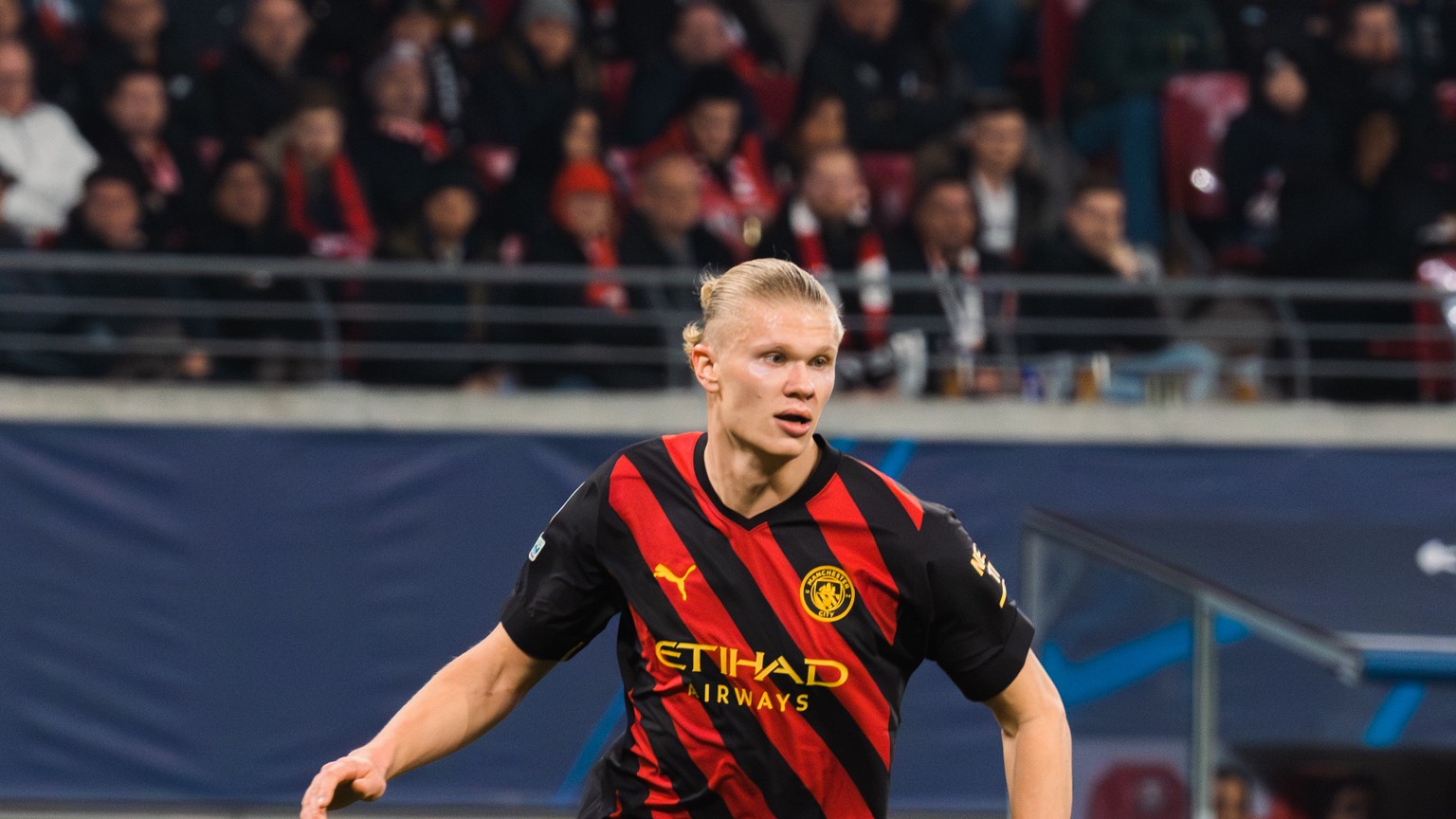
2. Raphinha is the #1 anytime scorer, not Haaland or Kane
The model's top five anytime-scorer probabilities for the tournament:
- Raphinha (Brazil): 55.3% (#1)
- Jonathan David (Canada): 47.5% (#2)
- Lionel Messi (Argentina): 46.9% (#3)
- Mikel Oyarzabal (Spain): 46.0% (#4)
- Erling Haaland (Norway): 45.1% (#5)
Harry Kane is 17th at 32.0%.
Most pre-tournament scorer lists start with Haaland and Kane. The model sees Raphinha as the clear favourite, and three inputs compound in his direction.
First, expected minutes. Raphinha projects as a 62-minute-per-match starter for Brazil. Kane projects at 52. That alone scales the per-match scoring rate by roughly 20%.
Second, tournament path depth. Brazil's expected 5.6 matches gives Raphinha more opportunities than a player on a team likely to exit earlier. Norway's expected path is 4.5 matches.
Third, penalty duties. Raphinha is Brazil's designated PK taker. The model adds a penalty-kick component to his per-match scoring rate, which lifts his baseline further.
Haaland's club npxG/90 (0.66) is higher than Raphinha's (0.55). But fewer expected minutes (59 vs 62), a shallower tournament path (4.5 vs 5.6 matches), and no PK designation close and then reverse that gap once the probabilities compound across the full bracket.
3. Iran has an 81% chance to advance, despite being ranked 26th
Iran's Elo (1760) puts them 26th of 48 qualifiers. Mid-table. Unremarkable. But the model gives them an 81.2% probability of advancing from the group stage.
The reason is Group G. Belgium is the clear top seed at 95.7% to advance. Iran is the clear second seed at 81.2%. Then there's daylight: Egypt at 67.1%, New Zealand at 24.9%. It's one of the cleanest top-two splits at the tournament. Iran doesn't need to be exceptional; they need to be better than Egypt and New Zealand, and by Elo, they comfortably are.
Context matters enormously in a group-stage format. A 26th-ranked team in a group with two teams ranked below them and one dominant favourite has a very different probability profile than the same team drawn alongside three top-15 sides. The model captures this; the FIFA ranking alone cannot.
4. Spain and Argentina are far above their FIFA-implied rate
The model's tournament-win probabilities for the top of the field:
- Argentina: 17.5% (FIFA-implied ~11.1%, delta +6.4pp)
- Spain: 16.9% (FIFA-implied ~12.5%, delta +4.5pp)
- Brazil: 9.7%, roughly half of either
Those are the two largest positive gaps between the model and a probability distribution derived from FIFA rank. Spain and Argentina are FIFA's #1 and #2, and the model rates them even higher than the ranking implies.
Meanwhile, several other top-10 FIFA sides sit below their FIFA-implied rate: England at -2.2pp, Belgium at -2.5pp, Netherlands at -2.4pp. The model sees a sharper concentration of strength at the very top than the FIFA ranking, which flattens the distribution, would suggest.
The mechanism is compound advantage through the bracket. A team that's slightly stronger on a per-match basis sees that advantage amplified across six or seven knockout rounds. The Monte Carlo simulation captures this compounding; a rank-based transform does not.
5. The USA is the underdog in every group match, at home
The model's win probabilities for the host nation in Group D:
- USA vs Paraguay: 32.3%
- USA vs Australia: 30.9%
- USA vs Turkey: 30.8%
In every match, the draw is more likely than a US win, and the opponent's win probability is competitive with or higher than the USA's. The model gives the USA a 73.0% chance of advancing from the group, which sounds healthy until you compare it with the other hosts: Mexico at 94.5%, Canada at 93.7%.
Group D is the tightest group in the 48-team field by every measure of competitive balance. First-place probabilities run from 31.1% (Turkey) to 18.9% (Australia), with the USA at 28.1%. No other group has all four teams packed into a 12-point band. The USA's home advantage is already baked into the model, and it still doesn't make them the favourite in any individual match.
This is not a claim that the USA will be eliminated. A 73% advance probability still means they go through roughly three times out of four. The point is the gap between perception (hosts usually cruise through the group stage) and the model's assessment of this particular draw.
Full deep-dive: USA in the tightest group →
None of these are predictions designed to be provocative. They're what falls out of the inputs (Elo, club xG, group composition, bracket structure) when the model runs its Monte Carlo without knowing which teams have bigger fanbases or more tournament pedigree.
The full forecast for all 48 teams is at /forecast/. Each fixture page shows the headline win/draw/win probabilities; per-fixture depth (full scoreline distributions and a four-model comparison) is available with the Standard Pass.
All numbers in this post are model outputs as of the June 11 snapshot. They are for research and educational purposes only, not betting advice, not financial advice, not recommendations to gamble. The model can be wrong. Methodology: /docs/methodology/. Full Terms of Use.