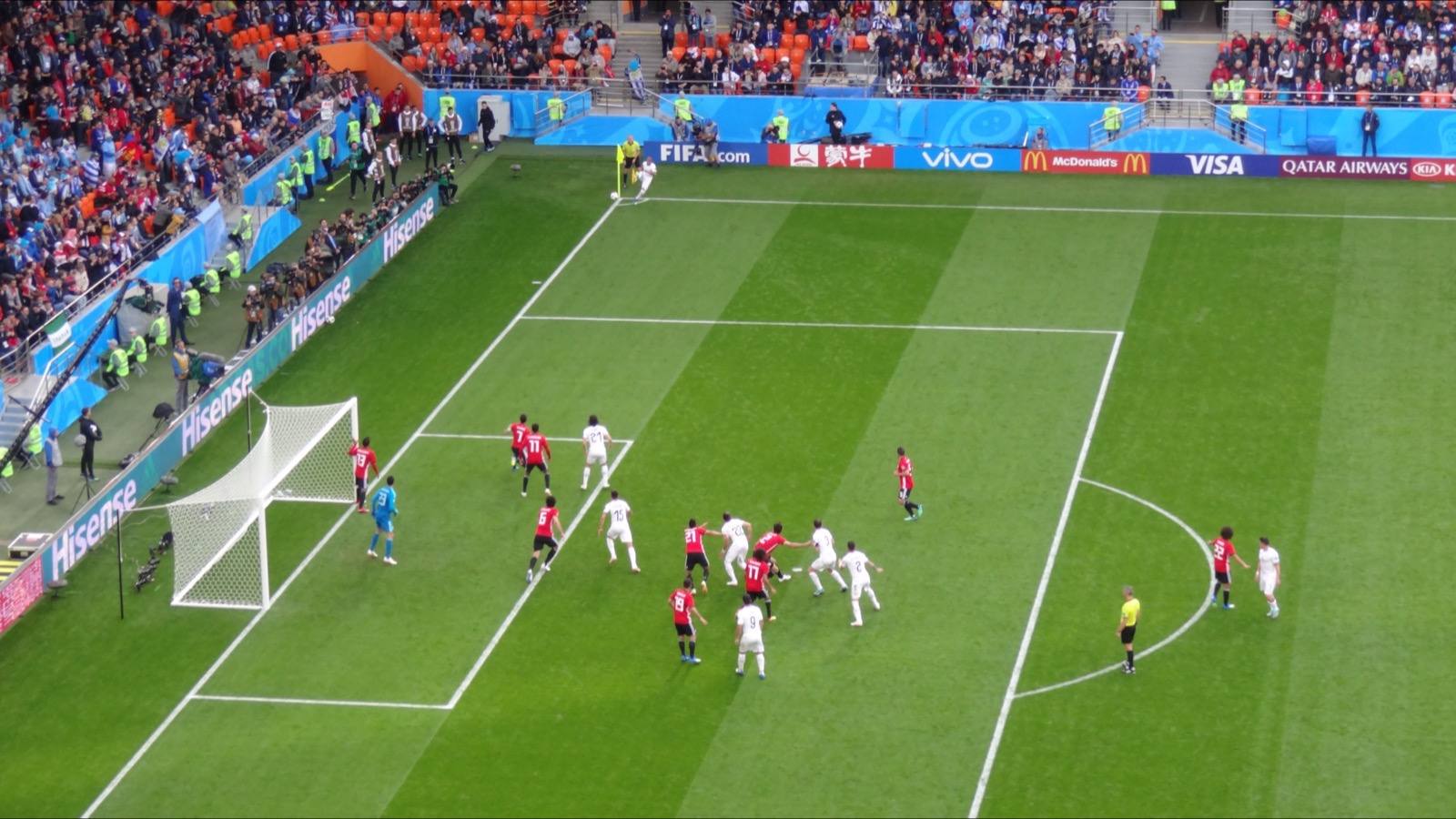
Not every team scores the same way. Some build patiently and break you down in open play; others are at their most dangerous when the ball is dead and the bodies pile into the six-yard box. At a World Cup, where one set piece can settle a knockout tie, knowing which kind of team you're watching matters.
So we measured it. We took every shot from the last three major-tournament cycles (the 2018 and 2022 World Cups, Euro 2020 and 2024, the 2024 Copa América, and the 2023 Africa Cup of Nations) and tagged how each move began. Four buckets: open play, a set piece (a corner or a free kick worked into a chance), a counter-attack, or a penalty. Then we did the same for the goals each team conceded. The result is a picture of how a side actually creates, and how it gets hurt.
The spread is wider than you might expect.
The set-piece teams
Three qualifiers depend on dead balls far more than the rest.
Uruguay are the clearest case in the field. Across 14 tournament matches, 11 of their 19 goals — 58% — came from set pieces. No other well-sampled qualifier is close. It fits the side's identity: physical, organised, happy to make a low-scoring game a test of who wins the box. Open play accounts for the other 42%; in this sample they did not score a single counter-attacking or penalty goal.
Colombia are next, at 50% (9 of 18 goals from set pieces over 10 matches), with a notable penalty share on top. Morocco, the 2022 semi-finalists, took 46% of their goals (6 of 13 over 14 matches) from set pieces — a reminder that the run to the last four in Qatar was built as much on set-piece organisation and goalkeeping as on open-play flair.
For all three, the message for an opponent is the same: the danger arrives when the whistle goes for a corner.
The open-play teams
At the other end are the sides that score almost everything from the run of play.
Spain are the purest example. Of 39 goals across 21 tournament matches, 67% came in open play — the highest share of any contender here. The tiki-taka inheritance is still visible in the numbers: Spain create through possession and movement, not the dead ball. Germany (65% of 23 goals) and Senegal (65% of 17) sit right alongside them, and the Netherlands (63%) are not far behind.
Even the two great South American sides belong on this side of the line. Brazil and Argentina each take 57% of their goals from open play. Argentina add a steady stream of penalties (13% of their goals) and the occasional counter; Brazil are similar. Neither is a set-piece team — for them the dead ball is a bonus, not the plan.
The other end of the pitch
How a team concedes is its own story, and it doesn't always match how it scores.
The most striking case is the Netherlands: a 63%-open-play attack that leaks goals the opposite way — 50% of the goals they conceded (7 of 14) came from set pieces. Morocco sit at the same 50%, and Brazil concede 43% of their goals from dead balls. For three sides that pride themselves on the ball, the route to hurting them runs through the set piece.
And then there is Uruguay, the one team that lives at both ends of the dead ball: 58% of their goals scored from set pieces, and 44% of the goals they conceded coming the same way. When Uruguay play, an unusual share of the match is likely to be decided in the air, from a corner or a free kick, at one box or the other.
Counters and penalties
Two smaller buckets round out the picture. Pure counter-attacking goals are rarer than their reputation suggests: across this sample, even the most transition-leaning contenders — Argentina, Brazil, Mexico — sit around one goal in ten from a genuine counter. And penalties, predictably, swing individual matches more than tournaments: Colombia (17%), Germany and Argentina (13%) drew the most of their goals from the spot, though over a handful of tournaments those rates are noisy.
What this is, and what it isn't
These are descriptive counts, not a forecast. They describe how each team has scored and conceded in recent major tournaments — a strong signal of footballing identity, but a backward-looking one. They are not inputs to our win probabilities: our model is results-driven and team-level, and it does not read a team's set-piece share when it projects the bracket. Think of this as context the headline numbers don't price — useful for knowing what a match is likely to look like, not for predicting who wins it.
You can see each qualifier's full goal-origin breakdown, for and against, on its country page.
A note on the sample
The figures come from public match-event data covering six completed senior tournaments. We count only teams with enough tournament matches to be meaningful, and we show the match counts so you can weigh them: a share built on 39 goals over 21 matches (Spain) is far steadier than one built on a dozen goals. We exclude penalty shootouts, which are a separate contest from the run of play. Because these are completed tournaments, the numbers are stable — they move only when the underlying open data is revised, not match to match. They describe the teams' recent past, which is the best guide we have to how they'll look in 2026, not a guarantee of it.
Where to read more
Every qualifier's goal-origin split sits on its country page, alongside how the team plays and where it ranks. The full 48-team forecast is on the tournament dashboard, and the methodology is at /docs/methodology/.
The goal-origin figures in this post are descriptive counts from public match-event data, for research and educational purposes only — not betting advice, not financial advice, not recommendations to gamble. Methodology: /docs/methodology/. Full Terms of Use.