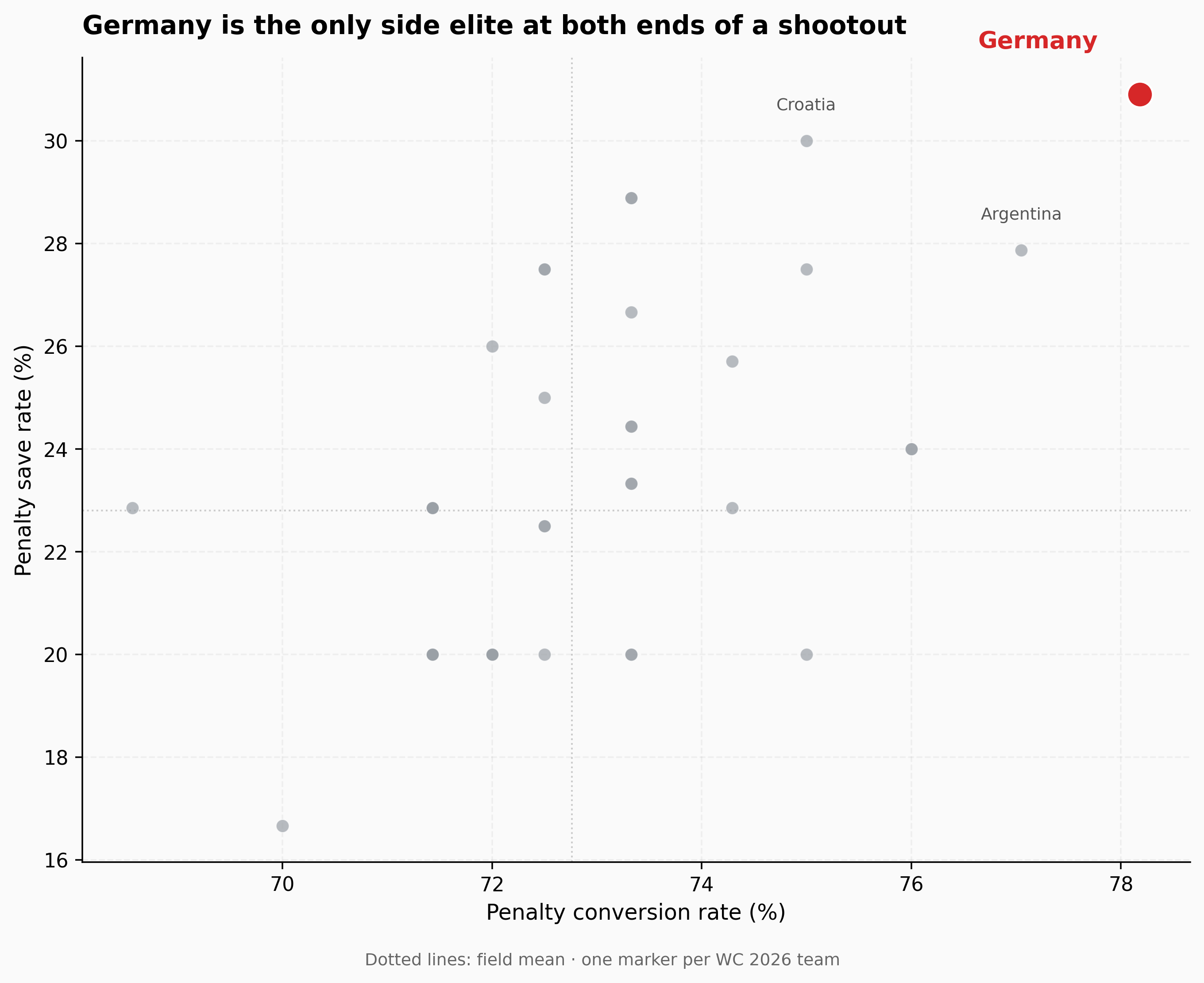
The cliche that Germans never miss from the spot turns out, for once, to be literally true in the model: Germany has the best penalty conversion in the field at 78.2% and the best save rate at 30.9% — the only team ranked first of 48 at both ends. And the model still makes Germany only its 7th-likeliest champion, at ~5.7%.
That tension is the whole post. The folklore checks out. It just buys less than the folklore implies.
The cliche, confirmed at both ends
Football carries a lot of national stereotypes that dissolve the moment you put numbers to them. This one survives. In the team-level model ratings that feed the tournament simulation, Germany's penalty conversion rate of 78.2% is the highest of all 48 teams — rank 1 of 48. Argentina are the nearest challengers, a step behind at 77.0%.
The save side is the rarer feat. A team can be good at scoring penalties and ordinary at stopping them; the two skills live with different people. Germany lead there too: a 30.9% penalty save rate, again rank 1 of 48, with Croatia second at 30.0%. Argentina convert but don't lead on saves; Croatia save but don't lead on conversion. Germany are the only side sitting first on both counts at once.
It is worth being precise about what this advantage is and isn't. Germany's set-piece goal share — the proportion of their goals that come from dead-ball situations generally — is 14.8%, which ranks 15th of 48. Middle of the pack. So the German advantage is the penalty kick specifically, not set pieces at large. They are not unusually dangerous from corners and free kicks; they are unusually reliable from twelve yards, taking and facing.
That distinction matters, because a penalty is a low-frequency, high-leverage event. A team that is merely good on corners gets small, frequent dividends across ninety minutes. A team that is elite from the spot gets a rare, enormous dividend exactly when a knockout tie refuses to resolve any other way.
So why is Germany only 7th?
Here is the number that complicates the story. Despite leading the field at both ends of a shootout, the model rates Germany only its 7th-likeliest champion, at ~5.7%. Six teams sit ahead: Spain at 16.7%, Argentina at 16.2%, Brazil at 9.6%, France at 9.1%, Portugal at 7.9%, and England at 6.2%. Germany's FIFA ranking is 9th, so the model is slightly kinder than the official table — but kinder still lands at seventh.
The chart below plots all 48 teams by penalty conversion (horizontal) against penalty save rate (vertical). It states the finding cleanly: Germany sit alone in the top-right corner, the only dot that is simultaneously furthest right and furthest up. The conversion leader among the rest and the save leader among the rest are annotated so you can see how isolated that corner is.
The resolution to the paradox is a point about when shootout skill gets to matter. Being the best penalty side in the world only pays off if you reach a penalty shootout — and only a shootout that is genuinely level, because a 30.9% save rate is an advantage over a 50/50 baseline, not a guarantee. A World Cup title, meanwhile, requires winning four-plus knockout matches, the large majority of which are decided in normal or extra time, long before anyone walks to the spot. Germany's elite penalty numbers are dormant in every match that doesn't go the distance, which is most of them.
Run Germany's group-stage and knockout path through the simulation and the staged probabilities tell the same story: the model has them at 98.5% to advance from their group, 66.8% to reach the round of 16, but only 11.6% to reach the final. The funnel narrows fast, and most of the narrowing happens in matches that never get near a shootout. By the time a tie is level after 120 minutes, Germany are genuinely favoured — but the model has already discounted most of their tournaments before they ever arrive at that moment.
The scenario test: real, already counted, still not enough
To size the spot-kick advantage directly, the model runs a counterfactual. Hold everything else about Germany constant — their attack, their defence, their draw, their path — and reset only their penalty conversion and save rate to league-average values (a 75% convert rate and a 20% save rate). Re-simulate the tournament and compare.
Resetting Germany's shootout skill to average cuts their simulated title probability by about 37% — roughly a third of their championship probability, gone, purely from making them ordinary at penalties. That is a large effect for a single, rare event. It confirms the advantage is real and that the model is genuinely rewarding it.
It also confirms the advantage is already inside the ~5.7%, not an unmodelled bonus sitting on top of it. The simulation resolves drawn knockout ties using each team's actual conversion and save rates, so Germany's shootout supremacy is one of the inputs producing the 5.7% in the first place. The honest framing is that 5.7% is what Germany are worth with their elite penalties counted; strip those out and they would be worth roughly a third less. "Best at both ends, still only 7th" is therefore a real tension in the model's worldview, not an artefact of leaving something out.
The reason the same advantage that drops them by a third when removed still leaves them only seventh when present is that the other six teams ahead of them are simply stronger across the ninety minutes that decide most matches. Spain at 16.7% and Argentina at 16.2% are close to three times more likely to win the tournament than Germany, and they earn that mostly before any shootout is reached. Germany's path to a title leans harder on the rare event than theirs does — the kind of route the folklore romanticises and the simulation quietly discounts.
If you like watching a national cliche meet a probability model and survive the encounter on a technicality, this is the one. Germans, in this field, really don't miss. Being the best in the world at the rarest moment in football just turns out to be worth about a third of your title chances, not the whole thing.
If you want the next one of these in your inbox, the newsletter is at /subscribe/.
All numbers in this post are model outputs. They are for research and educational purposes only — not betting advice, not financial advice, not recommendations to gamble. Methodology: link. Full Terms of Use.